The
Agitator
(2001/Radiance Blu-ray*)/Cobra
Kai: The Complete Series
(2018 - 2025/Sony Blu-ray Box Set)/Eiichi
Kudo Samurai Revolution Trilogy Collection
(13
Assassins
(1963,) The
Great Killing
(1964,) 11
Samurai
(1967)/Arrow Blu-ray Set*)/Red
Sonja 4K
(1985/Arrow 4K Ultra HD Blu-ray/*all MVD)
4K
Ultra HD Picture: B Picture: B-/B-/B-/X Sound: C+/B/C+/B-
Extras: C+/C+/B-/C Main Programs: C/C+/C+/D
PLEASE
NOTE:
There is a defect on Season 5 of Cobra
Kai
the grandmother of a key character has her Spanish subtitled by the
closed captions and printed-on-the-image yellow subtitles at the same
time and the captions are STILL THERE even when you try to turn them
off. We'll see if Sony corrects this.
Martial
Arts, criminality and swordplay eventually figures in each of the
following
new releases...
Takashi
Miike's The
Agitator
(2001) was the sometimes controversial director's three hour follow
up to his critical and commercial hit Ichi
The Killer,
about a tough yakuza captain having to take on double assaults on his
power and future when two underbosses come for him and his power.
For reasons I will not go into here but are on this new release, the
film was cut down and very badly, resulting in the longer, better cut
being lost in its best condition.
This
offers the usual violence and blood the director is known for, not as
stylized as some allege, nut is pretty much everything we have seen
before and cannot compete with the majority of great gangster genre
films issued in 1990 (Goodfellas,
State
Of Grace,
The
Krays,
Miller's
Crossing,
et al) so it has to rely on the acting and other parts of the story.
What's
really shocking is how the choices made to cut it down to the shorter
version are often so bad, it makes it just obnoxious to see versus
the longer one with at least some exposition that shows this could
work better, even when the director is trying too hard. At least
there is a subtle visual joke at the very end of the film, the same
ending retained in both cuts, worth catching for the fun of it.
Otherwise, this is for fans only.
Extras
include a
standard definition transfer of 200 minute extended version of
Agitator,
presented in its original two-part form
Newly
filmed interview with Takashi Miike (2025)
Audio
commentary by Tom Mes
Trailer
Reversible
sleeve featuring original and newly commissioned artwork by Time
Tomorrow
and
a Limited Edition booklet featuring new writing by Tom Mes.
Cobra
Kai: The Complete Series
(2018 - 2025) does something well that is only a more recent
phenomenon, reviving a franchise a few years later, picking up where
it left off, usually years ago. Sometimes this works (The
New Avengers
British spy TV series versus The
Avengers,
the Creed
films versus the original Rocky
films) and more often, it does not, as desperate-for-content 1980s
cable/satellite TV needed. Here, it is the original mid-1980s hit
Karate
Kid
films, as celebrated by a fan of them on Blu-ray a few years ago in
this review:
https://fulvuedrive-in.com/review/10006/The+Karate+Kid+I+&+II+(1984+++1986/Sony+Blu-ra
Not
as big a fan, I still see why they were hits and why people still
talk about them, though three more theatrical films later (The
Next Karate Kid
with future multiple Oscar Winner Hilary Swank, a rehash that was a
dud and a recent film with mixed results) made it to theaters, a
return to the original characters this series offers was not?
The
options are either a theatrical film, TV mini-series, cable
TV/telefilm or an actually series, and they went for the longest form
revival possible and it was a hit. Decades later, Ralph Macchio is
back as Daniel, a consistent success since we last saw him and first
met him, while the angry bully Johnny (the underappreciated William
Zabka) is not doing well at all, just hanging on, hanging on to
yesterday and stuck in the 1980s in several ways.
He's
asked to restart a dojo (karate school) but insists he has left that
life and world, but as the teleplays reintroduce all whom have
survived decades later and taken in the new world, the new elements
and eventual re-meeting of Johnny and Daniel builds up, et al. From
there, the series could have severely tripped up on itself or found a
new story to tell that was convincing and in line with both
expectations and unfinished business. The result is a series of six
short seasons that is more hit than miss that most fans will like,
but is more consistent than expected if not spectacular. The bottom
line is that all involved take it (and the fans) seriously and the
actors in particular are able to reestablish themselves as if there
was no gap in the decades since they last played their roles. That
ultimately is the most impressive thing about the series and the
result is they succeed where most revivals fail.
No,
its not stunning, but Cobra
Kai
loves the original films, karate itself and it shows. Yes, it could
have even been better in parts, but it tops most such revivals and is
a show everyone involved can be proud of.
Extras
include
for each season...
Season
One:
Season
Two:
Deleted
Scenes
Five
Featurettes
Blooper
Reel
Season
Three:
Deleted
Scenes
Blooper
Reel
Season
Four:
Deleted
Scenes
Blooper
Reel
Featurette
Season
Five:
Deleted
Scenes
Blooper
Reel
Season
Six:
The
Eiichi Kudo Samurai Revolution Collection
is an ambitious work with a harrowing start (a man rapes a woman and
kills her husband and even when someone commits suicide to bring
attention to what happened, the guilty man is too powerful to call
out and is about to become more powerful, leading to an assassination
plan by those who want justice.
If
you are going to offer such a serious situation with such subject
matter, there is no room for foolishness or ignorance and the films
handle it all well, with bad choices by the characters happening all
the way. Apparently making some political statements in the process
about Japan in its past and when the films arrived, we get
13 Assassins
(1963, later actually remade by Takashi Miike,) The
Great Killing
(1964) and 11
Samurai
(1967) that offer high stakes and challenge the viewer, telling their
stories the long way, leisurely, naturally and otherwise.
Though
each film has new characters, even when using the same convincing and
well cast actors, the look, fell and intent are the same. These are
more hit than miss and have some fine acting and great swordfighting,
but some parts of each can drag at least slightly and unless you
really can get into them, it is three full length films. I can
recommend them if you like these kind of films and they are better
than many of their contemporary counterparts, but expect some mixed
results just the
same.
The
name actors that keep showing up, whom many might recognize and not
be able to name unless they like these films and have viewed many of
them form the time, include Chiezo Kataoka (Bloody
Spear at Mount Fuji),
Ko Nishimura (Lady
Snowblood),
Kei Sato (Hara-Kiri)
and Toru Abe (Zatoichi
and the One-Armed Swordsman).
It is a must-see for fans.
Extras
include Limited Edition packaging with reversible sleeves featuring
original and newly commissioned artwork by Tom Fournier
Illustrated
collectors' booklet featuring new writing on the films by Chris D.,
Earl Jackson and Alain Silver
DISC
ONE - 13 ASSASSINS
Brand
new audio commentary by film critic and Japanese cinema expert Tom
Mes
The
Samurai Variations,
a brand new video essay by music supervisor and Japanese cinema
expert James Balmont on legendary composer Akira Ifukube's score for
the film
Samurai
Guerilla Part 1,
an archival interview where Eiichi Kudo's former assistant director
Misao Arai and filmmaker Dirty Kudo discuss Eiichi Kudo and Toei's
role in the Japanese film landscape of the 1960s
Theatrical
trailers
DISC
TWO - THE GREAT KILLING
Brand
new audio commentary by film critic David West
Magician
of Light and Shadow,
a brand new video essay by film critic and Japanese cinema expert
Daisuke Miyao on the cinematography seen in the film
Samurai
Guerilla Part 2,
an archival interview where Misao Arai and Dirty Kudo discuss the
jidaigeki genre and expand on the political dimension of The
Great Killing
Masaaki
Ito Remembers Eiichi Kudo,
a tribute to the director by his former assistant and brother-in-law
DISC
THREE - 11 SAMURAI
Brand
new audio commentary by film critic David West
Fighting
the Poison,
a brand new video essay by film critic and Japanese cinema expert
Jonathan Clements on the historical setting and context of the film
Samurai
Guerilla Part 3,
an archival interview where Misao Arai and Dirty Kudo discuss some
of the filming techniques seen in the film and the conception of the
Samurai as seen in Eiichi Kudo's jidaigeki films
and
Eiichi
Kudo: The Art of Realism,
an archival interview with Fabrice Arduini, filmmaker and programmer
for the House of Culture of Japan in Paris, where he discusses
jidaigeki and the films of Eiichi Kudo.
Richard
Fleischer's
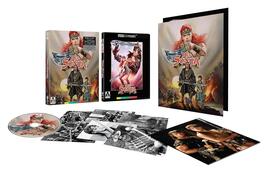
Red
Sonja 4K
(1985) is part of an odd cycle of 1980s female hero theatrical films
gone awry, all box office duds and all at one point, the male co-star
takes over control as antagonist as if the women are incapable of
saving the day. It happens in Supergirl
(reviewed elsewhere on this site) despite the outstanding casting of
Helen Slater and on Sheena
(both 1984) with Tanya Roberts. Here, you get Brigitte Nielsen who
also makes sense to cast, but then Arnold
Schwarzenegger shows up as a Conan-like character (advertising did
NOT correct the impression at the time, he was apparently tricked
into filming a cameo and landed up0 a co-star instead!) and the film
turns out as bad as the second Schwarzenegger Conan film that itself
wasted Grace Jones.
Even
with a great veteran like Fleischer
helming everything, it is really another sad entry in regressive
1980s cinema. Compare to the heroines on TV in the 1970s (Linda
Carter's Wonder Woman, Joanna Cameron's Isis, Lindsay Wagner's Bionic
Woman, even Elektra Woman & Dynagirl) or even Yvonne Craig's
Batgirl in the last season of the late 1960s Adam West Batman
series, and you can see and tell instantly the bizarre rollback
politics.
Additionally
frustrating as the title character goes for revenge for her family
being killed, they were even smart enough to cast the underrated
Sandahl Bergman to play the main villain and this still
does not work. The result is a flat curio getting serious deluxe
treatment from Arrow in a 4K edition where you can see and hear more
clearly than ever the seemingly endless errors, other mistakes and
unbelievably lame missed opportunities in a film that has not quite
achieved cult status, but would have worked with a better screenplay
and more honest approach. Instead, we get around 90 minutes of what
could have been on an almost Showgirls
level and no, the recent TV and theatrical film revivals of the title
heroine did not fix this. Now you can see for yourself, but just
make sure you are very awake and not operating heavy machinery.
Extras
include a brand new audio commentary by critics Eugenio Ercolani and
Troy Howarth
Brand
new audio commentary with comic book expert Dave Baxter
The
Prince and Me,
a newly filmed interview with actor Ernie Reyes Jr.
Swords,
Stunts and Sonja,
a newly filmed interview with action unit supervisor Vic Armstrong
The
Last of the Invincibles,
a newly filmed interview with Schwarzenegger's stunt double Pietro
Torrisi
The
Danish Girl,
a newly filmed interview with stuntman Ottaviano Dell'Acqua
The
12 Labors of Red Sonja,
a newly filmed interview with assistant production manager Stefano
Spadoni
The
Marvel of Primitive Technology,
a newly filmed interview with FX artist Domingo Lizcano discussing
the work of Emilio Ruiz del Rio
Moulding
Fantasies,
a newly filmed interview with make-up FX assistant Adriano Carboni
Bodybuilding
the Imagery,
an archival unreleased interview with poster artist Renato Casaro
The
Man Who Raised Hollywood,
an archive featurette on Schwarzenegger's career featuring
filmmakers Peter Hyams and Arthur Allan Seidelman, producer Edward
Pressman and others
Red
Sonja vs. Kalidor:
The Making of a Misunderstanding, an archive interview with
assistant director Michel Ferry
Theatrical
trailer
Image
gallery
Reversible
sleeve featuring two original artwork options by Renato Casaro
Collectors'
perfect-bound booklet featuring new writing on the film by John
Walsh, Nanni Cobretti and Barry Forshaw
Double-sided
foldout poster featuring two original artwork options by Renato
Casaro
and
six postcard-sized reproduction artcards.
Now
for playback performance. The 2160p HEVC/H.265, 2.35 X 1, Dolby
Vision/HDR (10; Ultra HD Premium)-enhanced Ultra High Definition
image on Red
Sonja 4K
was shot with Technovision cameras and anamorphic JDC Scope (and
possibly also Technovision) lenses. After a disastrous overseas 4K
release, the color was faded and awful, not the MetroColor it was
originally issued in, this new Arrow 4K version brings that color
mostly back, but it is still a little softer throughout than it
should be, especially with such good lenses and cameras. I've seen
it sharper and clearer at its best and they were lucky to have
Fellini and Visconti veteran Giuseppe Rotunno (Secret
Of Santa Vittoria,
Carnal
Knowledge,
All
That Jazz,
Popeye,
Adventures
Of Baron Munchausen)
as Director of Photography.
The
DTS-HD MA (Master Audio) 5.1 and 2.0 Stereo lossless mixes do their
best to upgrade the original theatrical
monophonic sound, but neither can hide the age and limited fidelity
(and budget) of the soundtrack, but the 5.1 is a little better just
the same. That gives us a decent combination, but not one that is
stunning, surprising, shocking or better than its few fans might
remember. Ennio Morricone's score could sound much better too.
The
1080p 1.85 X 1 digital High Definition image on Agitator
is for the shorter version only and though it can have some nice
color, grain is an issue and the color still has teal issues we are
seeing too ofter. Oddly, the teal is missing in the standard
definition version of the surviving longer cut, making it a little
more naturalistic in a few respects, though we can also call this a
lost film. Both versions have Japanese PCM 1.0 Mono sound that shows
its age and we guess is lucky to have survived as well as it had.
The combinations are a bit mixed, but the best we are going to see
the film for the foreseeable future and sadly, maybe ever.
The
1080p 1.78 X 1 digital High Definition image transfers on the Cobra
Kai
episodes are not bad, but a little soft at time, a little motion blur
is in other shots and I bet a 4K version could do a little better
image wise. The
DTS-HD MA (Master Audio) 5.1 lossless mixes are consistent,
professional, have decent soundfields and are easily the best
sounding releases here. The combination shows the makers took this
seriously and wanted the shows to match the early films and they
succeeded visually.
The
1080p black and white 2.35 X 1 digital High Definition image
transfers in the Eiichi
Kudo Samurai Collection
can show their age, partly due to how they were shot and how they
were stored and survived, but all three films still deliver nice
visual moments. Just do not expect great fidelity throughout for
their age, all shot in Toeiscope, the lenses also show their age with
fidelity limits and distortion as expected. Even a little more aged
are the Japanese PCM 1.0 Mono soundtracks that can be rough, but
sound about as good as these films ever will.
-
Nicholas Sheffo