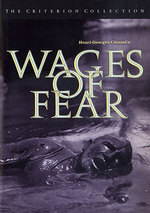
The Wages Of Fear (1953/Criterion Collection DVD)
Picture: C Sound: C Extras: D Film: A
PLEASE NOTE: Criterion has issued an excellent Blu-ray upgrade
to this film superior to this version and the PAL import we covered, plus has
issued a terrific Blu-ray of Diabolique
we have reviewed at this link:
http://www.fulvuedrive-in.com/review/11022/Diabolique+(1955/Criterion+Collection
For the record, we did not
get to officially review Criterion’s Wages
of Fear on Blu-ray, but we would rate it: Picture: B+ Sound: B- Extras: B
…if we had. Now for the original
text of the DVD review…
Made two years before his
slightly better known Diabolique,
Henri-Georges Clouzot's nail-biter of a suspense film Wages of Fear (1953) is the story of four broke and desperate men
stranded in Latin America. Eager for a way out of their respective
situations, they accept an American oil company's impossibly dangerous offer to
transport two truckloads of nitroglycerin across hazardous jungle terrain. Both of these films would be remade for
American audiences. In 1977, the film
would be renamed Sorcerer, which
would be directed by William Friedkin and star Roy Scheider. Diabolique
on the other hand would keep its name and star Sharon Stone in the 1996
version.
When Wages of Fear was released in America it was cut down from its
148-minute runtime and most of the cut footage occurred during the first half
of the film, in which most of the character development is building. Without these essential scenes, we lose some
of the strong sub-plots that are poured into the films foundation. There are so many instances of American
audiences being denied full director’s cuts of films that the very act of
cutting or censoring any film becomes a crime to cinema itself. Films such as Heaven’s Gate (1980), Brazil
(1985), Robocop (1987), or even Eyes Wide Shut (1999) have all been
butchered in some way making the experience all the more tedious. These are just some of the hundreds of
examples.
Three scenes during the
second half of this film that are sheer heart stoppers, even by today’s
standards. Without giving away what
these particular scenes are, they are all conducted in such a way that the
editing, the camerawork, and the direction are all in full force creating an
atmosphere of uneasiness bringing the viewer right into the moment. Looking at these scenes many decades later prove
once again that tension and suspense can be brought forth with more than some
moody music. What is essential is that
the scene manages to invite the viewer in and keep the viewer there. Once the director has this spellbinding
power, the possibilities are endless.
Wages of Fear would also bring popular music hall singer Yves Montand onto the
international playing level as a solid actor, who would go on to make some
spectacular films in America. A film
like this works well for certain reasons.
The assembly of the film itself is very simple. The storyline is nothing outstanding, but
strictly a straightforward narrative, which incorporates a small cast. This is a ‘mission’ film where the players
must complete a mission by the time the film ends, but there is much more to it
that lies just below that transparent surface.
There are four men who must carry explosive material across country, but
these men are split into two groups, who drive separate vehicles. The truck that gets the material successfully
to destination B first wins. This race
begins as a battle over pride. Each
truck with its two-man crew is destined to speedily make it to its destination
point without a care in the world. There
is even a moment where the men almost forget that they are carrying highly
explosive material, but are fueled by the challenge to be better than the other
group. Now these are men who were once
all friends. They each had similarities
among them and found common interests despite their differences, but a man
becomes more animal-like when there is something driving him to where his
reputation is at risk.
The title Wages of Fear works two separate
ways. For one, the men are being paid
wages for their work, which at this time they have little of, so they are
desperate. Their ‘wages’ equates to a certain
monetary value. These wages are based on
their ability to overcome their fears and deliver the product without
haste. The second meaning of the world
‘wages’ applies to what the men are willing to risk or a ‘wager’. These two meanings are fused as we watch
thinking back and forth about what these wages really are and amount to. Is it the money or is it their lives? What is the real risk? Most important are the subtle comments about
corporations and their blind eyes to humanity; seeing them more as
workers/labor/lower class than people.
This was of course fully discoursed in Fritz Lang’s classic 1927 Metropolis (reviewed in an extended
Blu-ray elsewhere on this site), but we get subtle hints of it here as well,
especially in this uncut version.
The Criterion Collection
released Wages of Fear in early 1999
with a decent transfer, but still has a problem showing some wear and tear to
the film. Luckily, Criterion has managed
to become a dominating force in the DVD market since 1999, and has more resources
to bring forth better editions of films, as well as invest in more restoration
to films. Perhaps this title will one
day be revisited either by them or another company, and deliver yet another
restored and improved version. The
full-frame black and white picture does not look overly terrible, but does show
some significant signs of dust, debris, and grain. Most of the problems are the white lines that
take away from the viewing experience to some degree. The white lines only appear sporadically. The transfer comes from a 35mm fine-grain
composite master, which is from a restored negative, explaining some of the
inconsistencies with the lighter to darker scenes, as well as why some scenes
look better than others. When producing
12” LaserDiscs, Criterion issued the film uncut for the first time.
From an audio experience
there is nothing overly impressive about this soundtrack other than the fact
that it sounds clean and clear, considering it is Dolby Digital 1.0 Mono. There is no movement in the mono soundtrack,
but dialogue is decent and the explosions are appropriately loud, with some
occasional distortion during these parts, which would have only been more
evident had this been a stereo remix. If
this film ever gets a Stereo mix or even a 2.0 Mono mix, there should be some
more restoration done in order to take the higher signal material, and bring it
down to a more moderate level, eliminating some of the harshness.
All in all, this DVD is
worth its weight just based on the fact that the film is a masterpiece. There are few older films that can still
compete on an adrenaline level like some of today’s films. What is also interesting is the different
dialogues throughout that are spoken, which makes the film easily accessible to
American audiences. Those not inclined
to watch black and white films or Foreign ones for that matter, might have to
settle for William Friedkin’s Sorcerer,
which is a valid film on its own, but does not compare to the original.
- Nate Goss