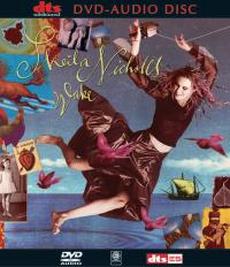
Sheila Nicholls - Wake (DVD-Audio)
Music: B+ MLP 5.1: A- DTS 5.1: A PCM
Stereo: B Extras: C+
Sheila Nicholls proves
what conviction can do when applied to what would in other ways be considered
annoying or even too preachy. She does
it with zest and appeal, as her songs tend to border on being too direct, her
passion is felt as she pours her soul into her work. Unlike many musicians working today, Nicholls’ knows how to keep
the right balance in her work. As a
follow up to her 1999 debut Brief Stop, Nicholls quickly demonstrates
that she is nowhere near ready to ever stop.
This time around her vocals cut even deeper than some of the tracks off
of Brief Stop such as “Fallen For You” which appeared that same
year in the John Cusack film High Fidelity.
Brief Stop showed off the singer/songwriters potential with
more piano-based compositions, but she quickly withdrew from that this time
around, probably to avoid being compared to Sarah McLachlan. Rather she comes out strong almost along the
same vein as Aimee Mann, although her lyrics are not quite written in the same
poetic manner, it is simply a matter of different approach. Wake shows a more charismatic
Nicholls’ who incorporates much more in terms of instrumentation and imagination. This was a perfect album for DTS
Entertainment to include as one of their DVD-Audio’s and to make this one of
their first featuring an ES Extended Surround channel. Perhaps they will go back and do Brief
Stop in the near future.
Wake opens with a very potent track called “How
Strong”, which starts out rather delicate, yet the chorus becomes richly
immersed with various arrangements while Nicholls vocals become lower and even
to the point of grunting as she charts new territory. Songs like this could be comparable with some of the work done by
Bjork, Ani Difranco, Fiona Apple, or even Tori Amos. This is one of the more steady tracks with a pumping bass line
that quickly establishes this DVD-Audio as one of the most incredible in terms
of sonic appeal and capabilities of being so solid, while at the same time
pulling together instruments from various channels.
This DVD-Audio is capable
of three playback methods, DTS 5.1, MLP 5.1, and PCM Stereo. All three are generously rich and detailed,
with the multi-channel mixes delivering far more in spatialness, which is the
obvious intent. What is surprising is
the amount of low-end presence that can be identified throughout. Even in slower, more dramatic songs the bass
is a constant steady force, but the vocals still penetrate through with
ease. Some listeners might find this
amount of low-end to be distracting, in which case they may want to consult the
MLP option since it tends to back off on the low end and bring forth a bit more
fidelity and separation.
Taking it one step further
this DVD-Audio is capable of discrete 6.1 channels of sound with the DTS-ES
option for those who have a 6.1 receivers and speaker setup. This allows for more back-channel coherence
as the gaps are filled between right surround and left surround. What tends to happen with ES channels for
music is that vocals are spit from the instruments in the surrounds similar to
how the vocals dominate the center speaker in the front and allow for the left
and right speakers to handle the instruments.
When it comes to film, the ES channels are designed to match on-screen
action much better and create more ambience in the surrounds with the musical
cues. However, the difference here is
that there is no set structure for how the mix must sound. The artist (in this case the mixer) has the
advantage of structuring the mix to their idea of a comfortable listening
experience. Utilizing modern technology
the mixer can give more separation between instruments and vocals and going
with ES channels seems to be the best way to go since even more of the vocals
are divided into each speaker.
Track Listing
How Strong
Bread and Water
Faith
Love Song
Maze
Ruby
Moth and the Streetlight
Seven Fat Englishmen
Won’t Get Lost In You
Come To Me
Breath
There is also a bonus
video presented on the DVD-Audio for the song “Faith”, which is an
interesting video something along the lines of a P.T. Anderson video. The video is capable of being played in all
three of the audio options as well. The
picture quality here is very natural with some haloing that can be annoying as
well. The colors are saturated and on
the verge of bleeding, but nothing too bad.
Since this is a full-frame video that was likely shot on a lesser
digital format, the results are admissible.
If Sheila Nicholls’ were
compared to a famous writer it might be that of William Blake, especially that
of Songs of Innocence and Experience.
For Nicholls’ seems to always tread the lines of asking why must
innocence be lost and that constant fear of losing the ‘inner child’. Not the fear of losing that inner child in
the same creepy way that Michael Jackson claims though. Perhaps its fair to say that her album Brief
Stop is more along the lines of ‘innocence’ while Wake is definitely more along
the lines of ‘experience’. Her
experiences and maturity shows through as we quickly learn by comparing the two
albums how she has managed to grow as a singer/songwriter and become more
evolved in her arrangements, but also in the material. The question now though is where do artists
like this go next. The industry in its
current state seems to be going through a change and moving towards a more
jazz-oriented basis with the success of artists like Norah Jones. Sarah Mclachlan’s Surfacing album
is well-over five years old at this point, so its hard to judge what will
become of female artists that want to incorporate piano and vocals, but still
have a more alternative sound. Not only
that, but look at the recent success of Jewel crossing over from a singer/songwriter
from Alaska to a Madonna-esque dance diva with her latest album O304.
Nicholls’ shows definite
promise as a musician willing to change and luckily her material presented here
allows for the music to truly be a highlight.
Although DVD-Audio is still not the hot-selling product that it could or
should be and (in the meantime) Sony’s SACDs do not exactly seem to be
capturing the market either, both have made impressive early claims in a market
ready for multi-channel music. Wake
is one of the reasons why.
- Nate Goss