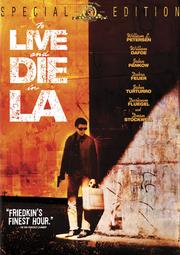
To
Live and Die In L.A. (1985/MGM DVD)
Picture:
B Sound: B Extras: B Film: A-
PLEASE
NOTE: This film
has been issued on a 4K disc set from Kino and though the picture is
the best color-wise yet, the image has all kinds of slight damage and
some other odd anomalies, but the soundtracks (especially the DTS MA
2.0 Stereo vs. the 5.1 mix) have major issues with all kinds of
volume variances, distortion and missing some sound range. The old
MGM Blu-ray is the best for sound, if not the Vestron LaserDisc, but
the film is going to need a new 4K scan for Dolby Vision 2, more
restoration money and that includes a new soundtrack that will need
to include getting the soundtrack soundmaster and remastering the
film for DTS:X and Dolby Atmos.
Some
films take too long to come to video, and even with the DVD boom,
there are still gems not available yet. Part of the problem comes
about when the film is an independent production.
Originally,
SLM Inc. financed William Friedkin's To Live and Die in L.A.
with a deal to have 20th Century-Fox (when they still had
the hyphen in their name) distribute. They also had James Cameron's
Aliens (1986) at Fox, but new owner Rupert Murdoch was
reportedly apprehensive of the content and distribution fell through.
MGM/UA
picked up the film, already having high expectations that Michael
Cimino's Year of the Dragon (1985) would be his big comeback
hit. It was not, but is now a minor classic. With that, MGM/UA went
on with Friedkin's film, but the commercial results were mixed.
However, it was made with such a low budget that it did not need much
to make its money back, and it had a soundtrack by Wang Chung that
even charted the title song. That did not work out either, but it is
now easily considered one of the 1980s best film scores.
When
the film finally came to home video, it was issued by the
long-defunct Vestron Video, who gave us Dirty Dancing. A 12-inch
LaserDisc was even issued, but even that was not widescreen, through
the digital version of the soundtrack holds up. Vestron eventually
went under, and then DVD eventually supplanted Lasers, so why the
hold up for this film? The rights!
Vestron
was absorbed by IVE, which became Live Home Video, which became
Artisan, which was just bought by Lion's Gate (aka Lionsgate.) There
were rumors that Artisan would do a special edition of the film.
Then, contrary rumors surfaced that was going to do it. Then MGM,
who did not have the film on video to begin with, said they thought
they would. However this finally worked itself out, MGM emerged with
the rights and the DVD is here and in its proper widescreen aspect
ratio for the first time ever since it was released in theaters.
The
film involves sex, murder, and money in the dark side of, but the
twist is that a good deal of the money is actually being made by an
expert counterfeiter Eric 'Rick' Masters (Willem Dafoe). In an era
before digital printing was so common, this film has a brilliant
pornographic moment of the money being duplicated in graphic detail.
Many were shocked, others were outraged, and it is one of the
greatest moments of staged criminal activity in cinema history. As
all coin and dollar bill collectors will tell you, one of the
greatest secrets of currency is that each one is a total work of art.
Great designers and minters are constantly making it as beautiful,
valuable and complex as they can, so to see it being 'ripped off' can
only be equated with people illegally downloading music artists'
work. Unlike that digitally easy act, it takes some serious
craftsmanship to duplicate paper money.
Dollar
bills had not changed much in all the decades before this film was
made, but you can instantly see the changes paper currency has gone
through in a much shorter amount of time. That still does little to
tarnish or diminish the sequence, which helps make the actual
counterfeit cash one of the stars of the film. However, this is an
incredible thriller about mature, adult, three-dimensional characters
and Friedkin keeps this shock on the sleazy level of the other
intense action throughout the film.
That
is where the opposition to the crime at hand comes in. Richard
Chance (William L. Petersen, a great actor far and beyond his TV
work) is a U.S. Treasury Agent who has this case on one hand, and his
partner retiring on the other. When things take a very ugly turn,
Chance intends to hunt down the elusive Masters at all costs. In one
way, this sets of the film spectacularly, but it turns out that
everyone else rises to this height of intensity one way or another
and the heat is far from the only reason.
Instead,
the screenplay by Friedkin and Gerald Petievich, based on Petievich's
book and experiences, shows that all the characters have the same
potential violence and anger. This is set off by the high stakes
that can mean wealth, prosperity, various kinds of freedoms, and the
thrill of risk-taking, not all of which is necessary. However, this
is a fast-lane way of life and the lines that separate right and
wrong dissipate very quickly, especially of the surfacing of all
kinds of pent up, repressed emotions and desires that are more likely
to surface under such a pressure cooker of possibilities. How well
these people known each other is at least as valuable as how much
they know themselves, and many of the surprises happen when they
either forget or simply do not know.
The
acting is exceptionally coy in being gutted out and laced with a
street-obscene mentality. Though the dialogue crosses gender lines
as a dark joke expressing the empty sense of self everyone tends to
have, the actions and visuals (including the editing) take this to a
new level of controlled breakdown and blurring. Add the high stakes
of wealth, death, and how the pleasure drive is inseparable form all
this, and you have an extremely intense, suspenseful thriller like
few others. The film moves in a way only a master filmmaker like
Friedkin could pull off. If you are too easily impressed by the lame
''end twist'' trend we have had to suffer through in recent bad,
overrated thrillers, you will find this especially intense.
As
for Petersen, if this film and Michael Mann's Manhunter (1986)
been the huge its they should have been, he would have been an A-list
action star and then some for years to come, but it is a loss to
filmmaking and all of us that this did not happen. The commercial
success on CSI is both absolutely no surprise and long, long
overdue, though the many hit spinoffs are still surprising. The
camera likes this guy and he is an actor who knows how to carry
himself, even in a comedy like Joel Schumacher's Cousins
(1988). Dafoe went on to become one of the most risk-taking actors
around, as did John Turturro (The Coen Brothers' Miller's Crossing
and Spike Lee's early successes), and Dean Stockwell. Even John
Pankow was willing to take on challenging films, like George Romero's
very clever 1988 opus Monkey Shines - An Experiment in Fear.
The film reminds us of a better time in filmmaking that was not that
long ago.
The
anamorphically enhanced 1.85 X 1 image is equal to practically any
DVD issued of a film from its time, including the recent issues of
Indiana Jones and the Temple Of Doom (1984), Divimax Edition
of Manhunter, James Cameron's Aliens (from the Quadrilogy
box) or near recent DVDs like Real Genius or Paul Schrader's
Mishima - A Life in Four Chapters (both also 1985). With some
of the best Video Black I have seen on an MGM DVD to date, it
projected very well, and Friedkin notes that the entire transfer was
digitally color timed to his specifications. It looks it, though,
there are some limits to clarity and depth from the digital itself
and the way it is downtraded to DVD (NTSC encoding, MPEG-2
compression, etc.), as I recall the reds and green being particularly
more vivid on the film print and even in some promo material. Wim
Wender's cinematographer Robby Muller shot the scenes with actors,
but left the action to other cameramen, who delivered brilliantly.
The various hands behind the camera did not hurt the look of the film
that crosses the glamorous with the sleazy in the most subtle ways.
This is also an exceptionally well edited film, with the cutting
making new meanings that otherwise would not be there.
The
original theatrical sound was Dolby A-type analog with the usual
monophonic surround, but even then, everyone was talking about the
exceptional soundtrack by New Wave music duo Wang Chung. Geffen
Records even reissued the soundtrack on CD a few years ago in a
decent sounding version. The only thing is, no matter how good, it
made me miss the film. Now, the DVD offers lossy audio options
including a French Dolby Digital 2.0 Stereo option with Pro Logic
surrounds, Spanish Dolby Digital 2.0 Mono, and an English Dolby
Digital 5.1 AC-3 mix that is very impressive. Wang Chung's brilliant
score really kicks in this remix, in which new materials and master
materials were brought in for better clarity and fidelity.
Though
some of the materials show their age, this mix is comparable and
worthy of the sound of the titles already noted on their respective
DVDs. Sound effects are well thought out, yet very consistent in a
narrative context, which is too rare. With better sound systems,
has, unfortunately come more aural distractions to show script
shortcomings, but not with any of Friedkin's films. Though the Wang
Chung music is multi-channel above mere ambience, I still hear limits
in warmth and bass versus the CD, however minute. Too bad this was
not one of MGM too-rare DTS editions, because this upgrade is
exceptional otherwise. We will have to wait for Geffen and Universal
Music to do the soundtrack as a High Definition sound Super Audio CD
or DVD-Audio to really appreciate the sonics of the Wang Chung music.
The
extras are no letdown either, and once again, Friedkin delivers all
on his own, another one of the best audio commentary tracks (director
or otherwise) you will ever hear. Though he never gets enough
recognition for it, Friedkin is one of the smartest filmmakers of his
or any generation. His films alone are often incredible, but add his
words, and you have must-have archival DVDs that belong in all
serious collections. On top of this, we also get a nice photo
gallery in still/step form, a preposterous alternate ending that
insults anyone with a brain, a deleted scenes that Friedkin says he
wish he could reinsert into the film if it only existed in a film
print (and he would be right in doing so), the original teaser and
trailer from when MGM/UA distributed the film back in 1985, and a
terrific making of documentary appropriately entitled Counterfeit
World. The only extra I did not like is the summary of the film
on the back of the DVD case giving too much away.
For
a film that has been neglected and even forgotten for so many years,
it is now back with a vengeance, as it should be. No one could have
ever expected such an exceptional DVD or one that was so loaded.
Petersen's hit TV series CSI, also on DVD and selling well
enough, sure did not hurt the cause. Either way, this is now one of
the gems in MGM's catalog, which they have done right by. Everyone
should have To Live and Die in L.A.!
-
Nicholas Sheffo